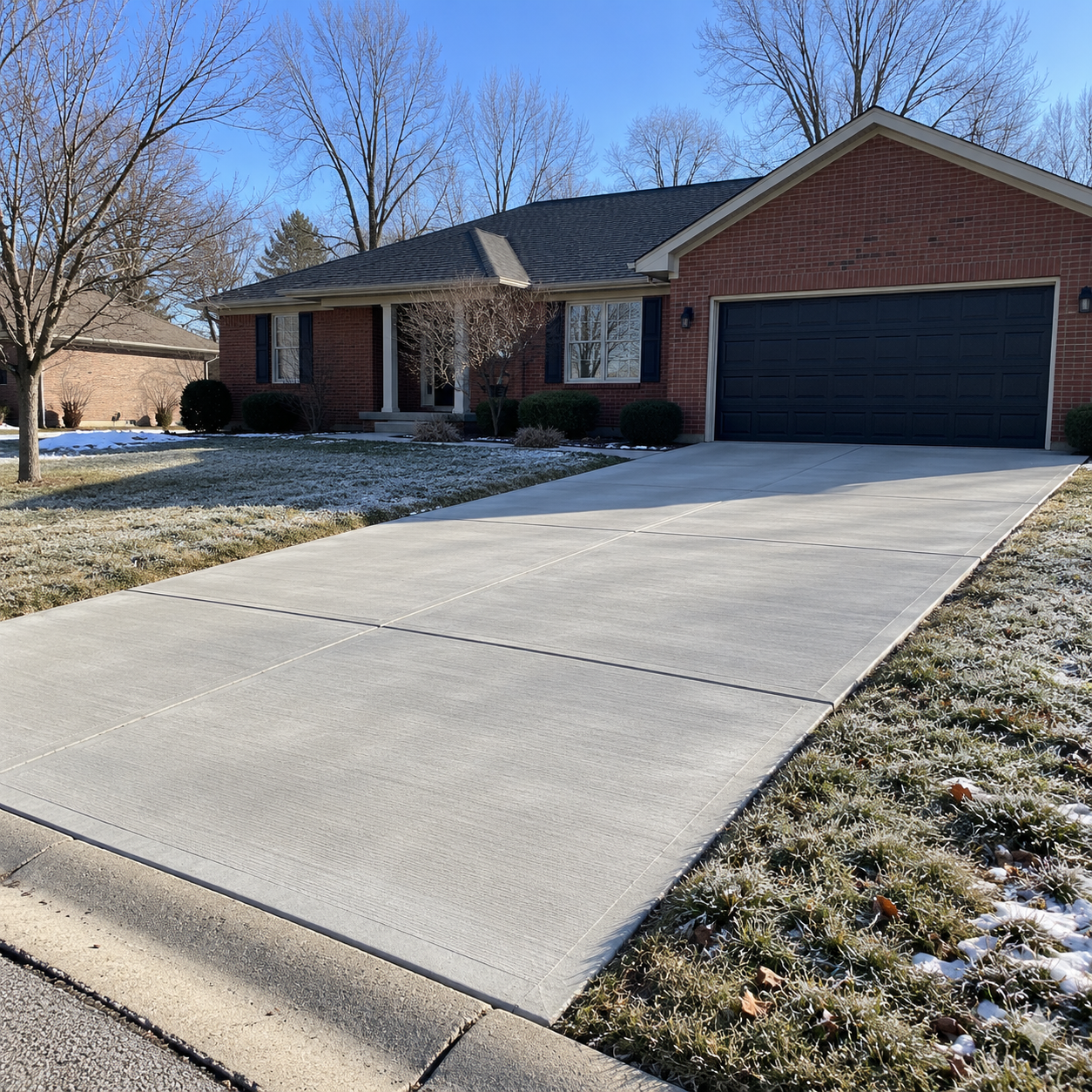
What Counts as Cold Weather for Concrete
The concrete industry's cold-weather guide, ACI 306, considers it cold weather when the air temperature has dropped, or is expected to drop, below 40°F during the period when the new concrete needs protecting. That is a low bar in Central Kentucky. From late November through early March, nights in Winchester, Lexington, Richmond and Mt. Sterling regularly fall into the 20s and 30s, even when the afternoons feel mild.
So the real question isn't "Is it winter?" but "What will the concrete go through in its first few days?" A 50°F afternoon pour followed by a 22°F night is a cold-weather pour, and it needs a plan.
Why Cold Is Hard on Fresh Concrete
Concrete doesn't dry. It hardens through a chemical reaction between cement and water called hydration. Cold slows that reaction down, and freezing can stop it in its tracks. Here's what that means on a real job:
- Early freezing can permanently weaken the slab. If the water in fresh concrete freezes before the concrete has gained enough strength, the ice expands inside it. A slab that freezes in its first day or two can lose a large share of its final strength and durability, and no amount of curing afterward brings that back.
- Strength comes in slowly. At 40–50°F, concrete gains strength far more slowly than it does at 70°F. Forms stay on longer, finishing takes longer, and the slab needs more time before it can carry foot traffic or vehicles.
- The ground matters as much as the air. A lot of Central Kentucky sits on clay soils over limestone. Clay holds water, and when it freezes it heaves. Pour on top of frozen clay and the ground settles as it thaws, leaving the slab unsupported. That is a common cause of early cracks and sunken sections.
- Freeze-thaw cycles and road salt come right after.
Kentucky winters don't stay frozen. They bounce above and below 32°F again and again. Each cycle pushes water into the surface and freezes it. Add deicing salt and you get scaling and flaking. Young concrete is the most vulnerable to both.
The Cold-Weather Rules a Good Crew Follows
Cold-weather concrete work in Kentucky is not one trick. It is a run of small decisions separating a pour that lasts from one that flakes by spring.
1. Never Pour on Frozen Ground, Snow or Ice
The subgrade must be thawed, firm and frost-free before concrete goes down. Frozen ground gets heaters or blankets first, or the pour moves to another day. Groundwork leads in every season, which is why grading, compaction and base prep come first on any
concrete slab installation in Winchester.
2. Use a Mix Built for Cold and Freeze-Thaw
Exterior concrete in Kentucky should be air-entrained. Those tiny air bubbles give freezing water room to expand, the main defense against freeze-thaw damage and salt scaling. A supplier may also add heated water and a non-chloride set accelerator, since chloride corrodes steel.
3. Pour Early, on the Right Day
In winter we read a multi-day forecast, not just pour day. The best window starts in the morning, with rising temperatures and no hard freeze for two nights. Wind counts too, since it pulls heat from a slab faster than still air.
4. Protect the Slab, Then Uncover It Slowly
Once finished, the concrete gets covered, usually with insulated curing blankets, and in harder cold the area can be enclosed and heated. The goal is to keep it from freezing until it reaches roughly 500 psi, usually the first couple of days. Blankets come off gradually, since stripping a warm slab on a frigid morning can crack it.
Go or Wait? Reading the Central Kentucky Forecast
Every job is different, but this is how we think about the forecast for the days around a pour. The final call is always made on site.
NOT SURE IF YOUR PROJECT SHOULD WAIT?
When Waiting Is the Smarter Call
A good contractor will tell you when to hold off, even if it means waiting for spring. We recommend waiting when:
- The ground is frozen and can't be thawed and kept thawed.
- A hard freeze or a run of below-freezing days is forecast right after the pour.
- The project needs a dry, firm base after heavy rain or snowmelt and the site hasn't drained.
- It's a decorative job, such as stamped or colored
concrete patios, where color, release agents and sealer all depend on mild, dry weather.
The main reason for rushing is a holiday or event, not a real need. A driveway that lasts 30 years is worth a few weeks' wait.
How RM Global CONCRETE handles cold-weather pours
Our motto is simple: doing it right costs less than doing it over. In winter, that means we look at the forecast and the ground before we commit to a date, and we'll tell you honestly if your project should wait.
- Site check first. We evaluate grading, drainage and soil conditions before scheduling, the same as any season.
- A plan for the forecast. We track the forecast for the days before and after your pour, not just pour day. If the weather turns, we'll call you and move the pour to the next good window.
- Protection built into the plan. If your pour needs blankets, ground heaters or an enclosure, we'll tell you up front and spell it out in your estimate, so there are no surprises.
- Clear aftercare instructions. After every pour we explain when you can walk and drive on the new concrete, and what to avoid during its first winter.
- Backed by a written workmanship warranty on qualifying projects, reviewed with you during the estimate, including how it applies to a cold-weather pour.
Permits and Winter Work in Clark County
The Building Inspections office on Wall Street issues permits for the City of Winchester and all of Clark County, and one is required for structures of 200 square feet or more, plus parking lots. Replacing flatwork on its existing footprint usually falls outside that, while a slab under a new garage or addition does not. Check the
Winchester building permit requirements before you set a date.
Planning a spring pour? Book in winter
If your project is better off waiting, winter is still the best time to plan it. Getting your estimate, design and permits (if needed) done over the winter means you're on the schedule for the first good weather in spring, before the busy season fills up. We give estimates all winter, so reach out now to get on our spring schedule.
We serve Winchester, Lexington, Richmond, Georgetown, Nicholasville, Mt. Sterling and communities within about an hour. See all the
areas we serve.
Frequently Asked Questions
Does Winter Concrete Cost More?
It can. Heated water, accelerators, blankets, ground thawing and enclosures all add material and labor. How much depends on the project and the weather that week, so ask for it itemized in the estimate.
How Long Before I Can Drive on Concrete Poured in Winter?
Longer than in summer. Cold slows strength gain, so a driveway that takes a week in July can need closer to two in January. Your crew should give you a date.
Will a Winter Slab Look Different From One Poured in Summer?
It can, slightly. Slow curing and accelerators sometimes leave a lighter or mottled surface. Even protection keeps it minor.
What Happens if an Unexpected Freeze Hits After My Pour?
That is what the protection is for. Blankets stay on and get doubled if needed, heat comes in if the cold runs deep, and the slab gets watched.
Talk to a Local Concrete Contractor About Timing
Not sure whether your project should go in now or wait for spring? RM Global Concrete is a family-owned, licensed and insured concrete contractor in Winchester, KY. We'll look at your site, check the forecast with you and give you a straight answer.
Call
(859) 771-6494
or request a free estimate to talk through your project.
REQUEST A FREE ESTIMATE
CALL US NOW